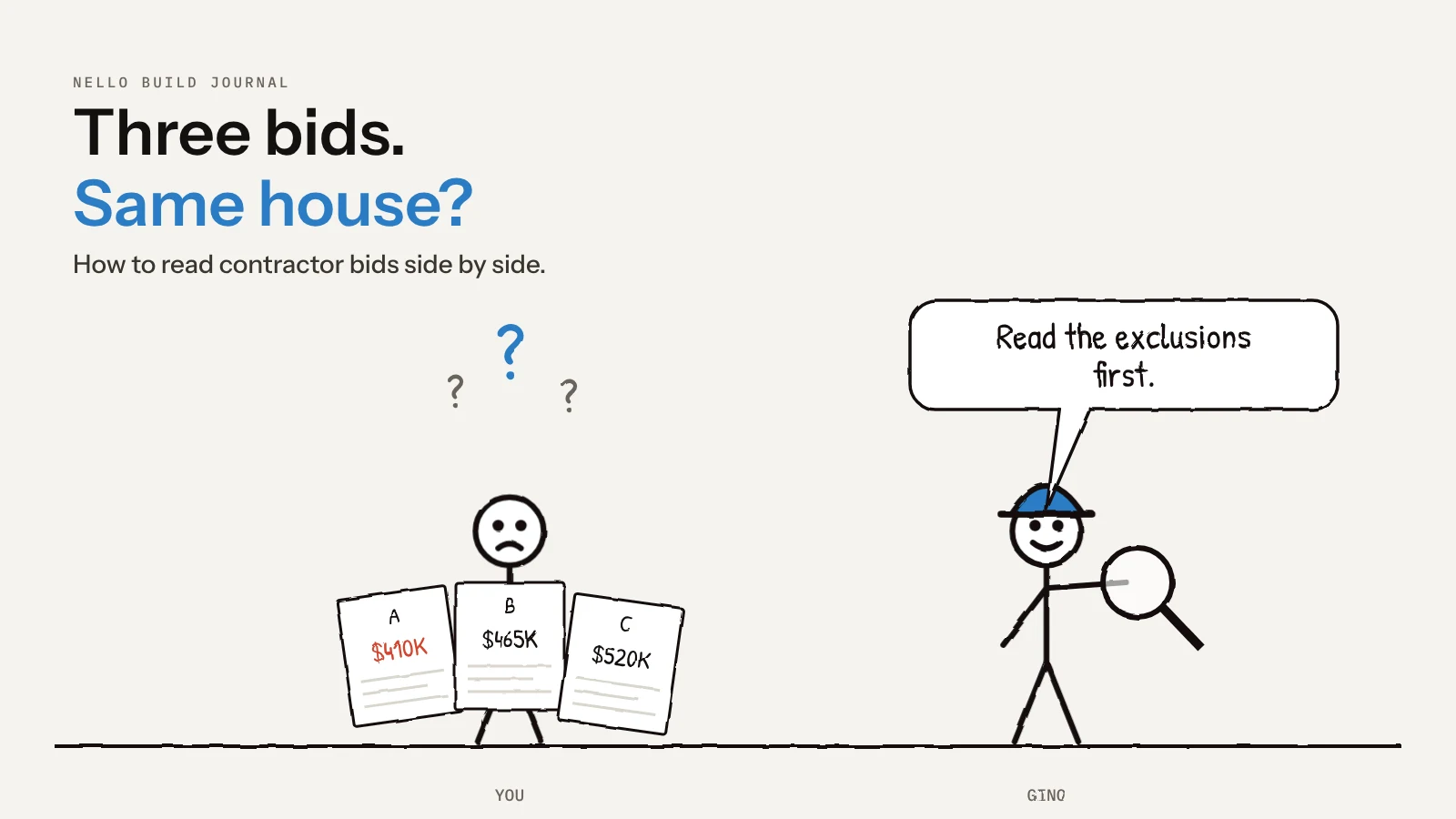
The lowest bid is rarely the cheapest job. To compare contractor bids in Naples, put them side by side and check seven things: that everyone priced the same plans, what each one excludes, how big the allowances are, what’s in general conditions and fee, the schedule, the payment terms, and the contractor’s license and insurance. Do that and the real gap between the bids usually looks very different from the totals on the first page.
I ran a general contracting company for about 25 years before I moved to Naples, and I’ve been on both sides of this. I’ve written bids that lost to a lower number, and I’ve watched owners pick the low bid and pay more by the end. Neither side is usually lying. They just priced different jobs. Here’s how I’d read three bids if I were the owner.
Why three bids on the same house can be $100,000 apart
Say you get three bids on a new house: $410,000, $465,000 and $520,000. It’s tempting to throw out the high one and negotiate with the low one. But in my experience the spread almost always comes from what’s in and what’s out, not from one contractor being greedy. The low number might leave out the impact windows, carry a $12,000 cabinet allowance, and skip permit fees. The high one might include all of that plus a real contingency. Once you line them up, they’re often a lot closer than they look.
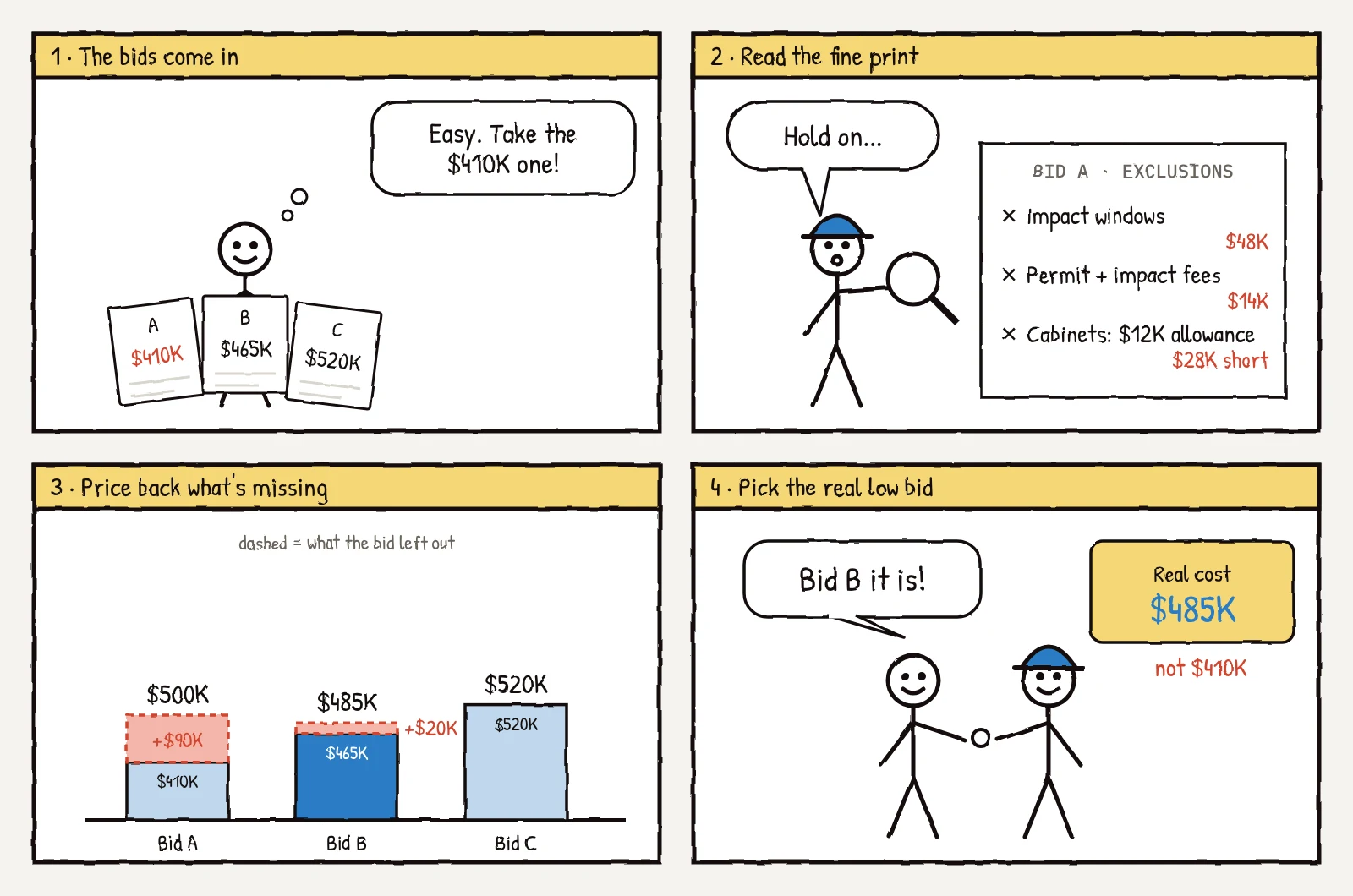
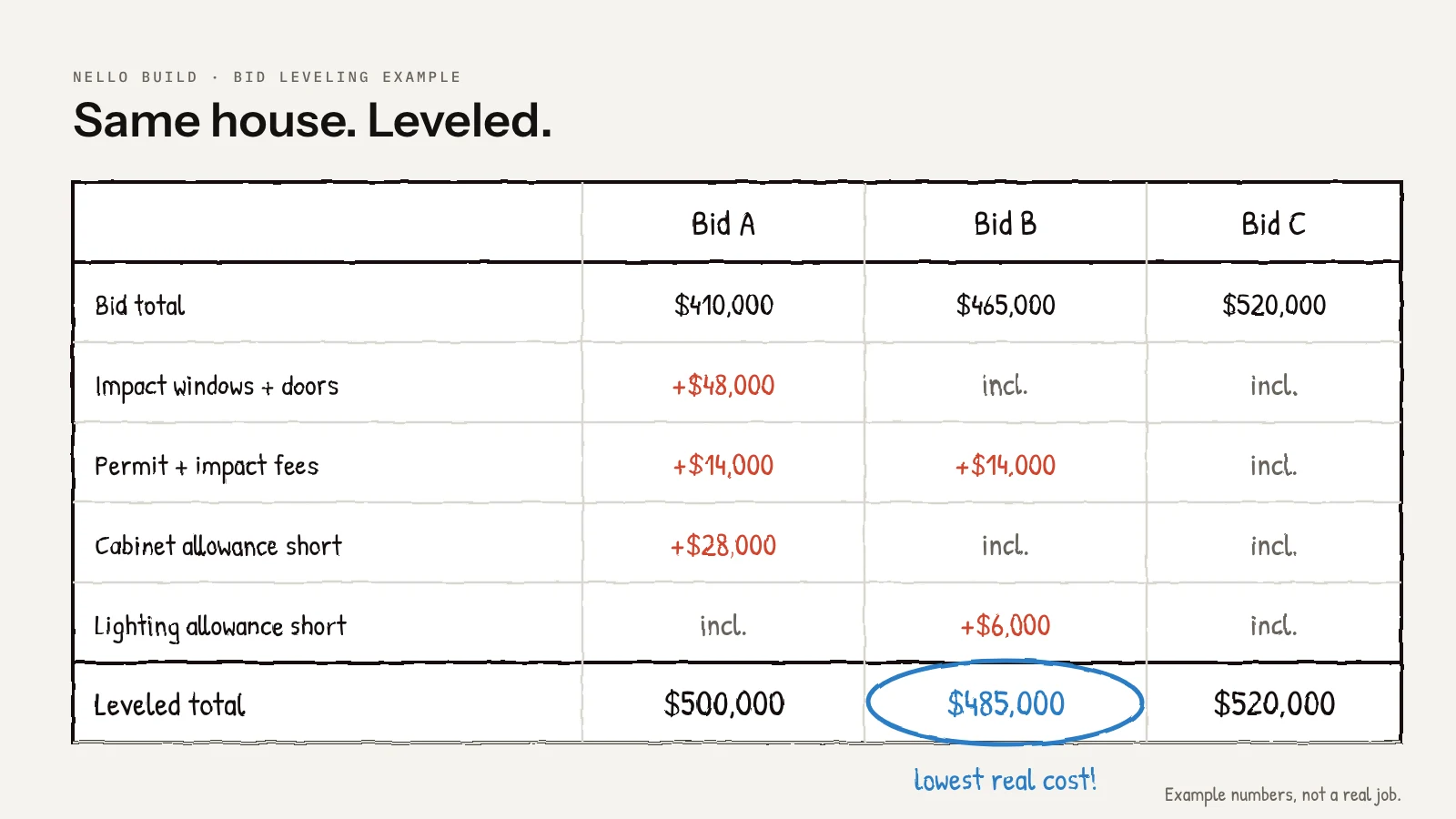
Here’s how that example levels out once you price back in what each bid left out:
| Line | Bid A | Bid B | Bid C |
|---|---|---|---|
| Bid total | $410,000 | $465,000 | $520,000 |
| Impact windows and doors | +$48,000 | Included | Included |
| Permit and impact fees | +$14,000 | +$14,000 | Included |
| Cabinet allowance shortfall | +$28,000 | Included | Included |
| Lighting allowance shortfall | Included | +$6,000 | Included |
| Leveled total | $500,000 | $485,000 | $520,000 |
The “cheap” bid ends up $15,000 more than Bid B. Bid C is the highest, but it carries a $15,000 contingency the others don’t, so it’s closer than it looks too. These numbers are an example, not a real job, but the pattern is one I see all the time.
1. Make sure everyone bid the same thing
Check that every bid lists the same plan set, the same revision date and any addenda. If one contractor bid an older set or “value-engineered” something without telling you, you’re comparing apples to oranges. A good bid says exactly which drawings it’s based on.
2. Read the exclusions first
This is where most of the money hides. In Naples, these are the ones I see left out most often:
- Permit fees and impact fees
- Survey, elevation certificate and soil testing
- Impact windows and doors, or the hurricane protection package
- Pool, landscaping, irrigation and driveway
- Utility connections and temporary power
- Builder’s risk insurance
- Termite treatment and final cleaning
None of these are wrong to exclude, as long as you know. Ask every contractor to price the same list, or at least to say who’s responsible for each item.
3. Check the allowances
An allowance is a placeholder budget for something you haven’t picked yet, like cabinets, tile, lighting or appliances. A bid with low allowances looks cheaper, and then the real number shows up later as a change order. If one bid carries $15,000 for cabinets and another carries $40,000, the second one isn’t more expensive. It’s more realistic. Line the allowances up item by item.
4. Understand general conditions and fee
General conditions are the cost of running the job: the superintendent, dumpsters, temporary toilets, equipment, cleanup and insurance. The fee is the contractor’s overhead and profit. Some bids show these clearly. Others bury them in the line items. A bid with very low general conditions on a long job is a warning sign. Somebody still has to be on site every day.
5. Look hard at the schedule
Ask each contractor how long the job takes and what it’s based on. In Southwest Florida, permitting, impact window lead times, inspections and hurricane season all move the calendar. A schedule that’s much shorter than the others isn’t a feature if it isn’t real. Every extra month costs you rent, a carrying loan or a delayed move-in. More on that in how long it takes to build a custom home in Naples.
6. Read the payment terms
Payments should track the work, not get ahead of it. Florida law has a protection here. If a contractor takes more than 10 percent of the contract price up front on a residential job, they have to apply for permits within 30 days and start work within 90 days after the permits are issued, unless you agree in writing to longer. A big deposit isn’t automatically a red flag, but you should know the rule.
Also ask about retainage, how change orders are priced, and what happens to any unused contingency.
7. Check the license, insurance and lien paperwork
- License. Look the contractor up on the Florida DBPR license search at myfloridalicense.com. Make sure the license matches the company name on the bid.
- Insurance. Ask for a certificate of liability insurance and workers’ comp, sent straight from the insurance agent.
- Notice of Commencement. For most jobs over $5,000, Florida’s lien law calls for a recorded Notice of Commencement before work starts.
- Lien releases. Before you make the final payment, get a final release of lien from the contractor and from any sub or supplier who sent you a Notice to Owner. Otherwise you could end up paying twice for the same work.
A simple way to line them up
Put the bids in columns and these items in rows: plan set and date, exclusions, allowances, general conditions and fee, contingency, schedule, payment terms, license and insurance. Then add the excluded items back into each total at a realistic number. The bid that comes out on top after that is the one to talk to.
When the low bid is the right one
Sometimes it is. If the low bidder priced the same scope, carries realistic allowances, has a believable schedule and checks out on license and insurance, take it. The point isn’t to pay more. It’s to know what you’re paying for before you sign.
Bid analysis as a service
Most people build or renovate once or twice in their life. Contractors bid every week. That’s not a fair fight, so I offer bid analysis as its own service. You don’t have to hire Nello Build to build the job.
Here’s what you get:
- A side-by-side bid-leveling sheet with every bid put on the same scope, line by line.
- The missing costs priced back in. Exclusions and thin allowances get a realistic Naples number, so you see what each bid will really cost.
- A read on the risky parts: general conditions, contingency, schedule, payment terms and how change orders are handled.
- License and insurance checks on each bidder.
- A list of questions to send back to each contractor, so they have to clarify before you sign.
- A call to walk through it and talk about which bid I’d pick, and why.
It’s for homeowners building or renovating, condo associations comparing bids on a big repair, landlords and tenants pricing a commercial fit-out, and investors who want a second set of eyes before they commit. I’ve written and reviewed bids for most of my career, and I hold a Florida general contractor license, so I know where the numbers usually hide.
It’s billed at a flat hourly rate, so you only pay for the time your bids actually take. And when I review bids for you, I’m working for you. If I review the bids on a job, Nello Build won’t bid that job afterward. That wouldn’t be fair to you or to the contractors who bid. If you want more help after the bids, like someone on your side through construction, that’s what our owner’s representation service is for.
To get started, send the plans and the bids you have to gino@nellobuild.com, or call (239) 686-1452.
How we bid at Nello Build
When we’re the ones bidding, we hold ourselves to the same standard. We list our exclusions and allowances on the first page, show general conditions and fee as their own lines, and tie the schedule to permitting and lead times we’ve actually seen in Collier and Lee counties. Because we work alongside Luca Architects, we also catch drawing gaps before they turn into change orders. On the design side, Luca prices its work the same open way: architect fees built from hours, not a percentage.
Common questions
How many bids should I get for a construction project in Naples?
Three is a good number. Fewer and you can't spot an outlier. More and it gets hard to level them properly.
Why is one contractor's bid so much lower than the others?
Usually because it leaves things out, carries low allowances, or assumes a faster schedule. Read the exclusions and allowances before you compare totals.
Can someone review my contractor bids for me in Naples?
Yes. Nello Build offers bid analysis as a standalone service. Gino Torriero, a Florida Certified General Contractor, levels the bids on the same scope, prices back in what's missing, checks license and insurance, and walks you through which bid makes sense. It's billed at a flat hourly rate, and Nello Build doesn't bid jobs it has reviewed bids for.
How much deposit can a Florida contractor ask for?
Florida doesn't set a cap, but if a contractor takes more than 10 percent of the contract price up front on a residential job, they have to apply for permits within 30 days and start work within 90 days after permits are issued, unless you agree in writing to longer.
How do I check a contractor's license in Florida?
Search the contractor or company name on the Florida DBPR license portal at myfloridalicense.com, and make sure the license is active and matches the company on the bid.
What is a final release of lien?
A signed document saying the contractor, sub or supplier has been paid and gives up the right to file a lien on your property. Collect them before you make the final payment.
This is general information, not legal advice. For your own contract, talk to a construction attorney. Gino Torriero is a Florida Certified General Contractor (CGC1536213) and leads Nello Build in Naples. He was CEO of Nello Construction in Pittsburgh for about 25 years.
