Having moved from Pittsburgh, where union labor is overpriced and sitework has many inefficiencies, as half the time you are leveling a side of a hill or filling in a valley, it has taken me a while to come to terms with what construction costs in Southwest Florida.
The land is flat. That is where the savings stop.
A Naples lot rarely needs the earthwork a Pittsburgh hillside does. But everything downstream of the slab costs more here, and owners who benchmark against another market get a number that is wrong by a wide margin before the first subcontractor is called.
For a sense of scale: a custom home in Naples commonly costs $400 to $800 per square foot to build today, and waterfront or highly finished houses pass $1,000. Commercial tenant fit-outs in Collier and Lee County run from under $100 per square foot for a simple office to $300 or more for a restaurant or medical suite. An owner arriving from Pittsburgh or Ohio with a number a third lower in their head is not wrong about their market. They are wrong about this one.
What actually drives the number in Collier and Lee County
Wind code. Southwest Florida builds to among the strictest wind-borne debris requirements in the country. Impact glazing, engineered connections, roof attachment and shutter systems are not upgrades here — they are the baseline, and they price accordingly. Impact windows and doors alone commonly add $50,000 to $100,000 to a custom home compared with standard glazing.
Flood elevation. Base flood elevations set the first floor, and raising a building is structure, fill, stem walls and stairs before it is anything visible to the owner. Two or three feet of elevation on a slab-on-grade house is tens of thousands of dollars before the first wall goes up.
Insurance and bonding. Builder’s risk and general liability carry a Florida premium, and every subcontractor prices their own coverage into their number.
Impact fees and permitting. Collier and Lee County impact fees, utility connections and review timelines are real line items. Impact fees on a new single-family home in Collier County alone run in the tens of thousands of dollars. A project that assumes another county’s schedule will miss its dates and pay for the delay.
Subcontractor demand. Season concentrates the work. The same trade that quotes competitively in August is booked solid in January, and hurricane recovery cycles pull crews out of the market entirely for months at a time.
Material logistics. Southwest Florida is at the end of the supply line. Freight, staging space and lead times all cost more here than in a market with three interstates through it.
Where owners lose money that has nothing to do with the market
Contracts where the owner never sees a subcontractor bid. Lump-sum contracts priced off drawings too thin to build from, which arrive as change orders later. Selections made after construction starts. And the most expensive of all: a design that was never priced until it was finished.
Change orders on lump-sum residential work commonly run 5 to 10 percent of the contract, which on a $3 million house is $150,000 to $300,000. Almost none of that is the market. It is the sequence.
A project example
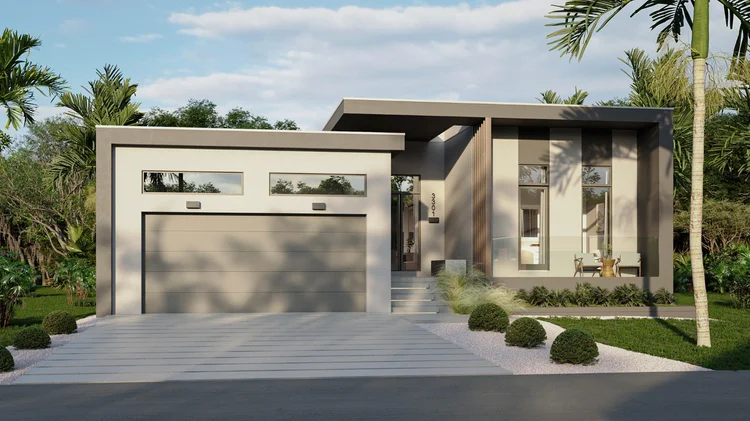
The clearest example I have is not in Florida. St. Joe’s Catholic Church in Etna, Pennsylvania was a 45,000 square foot addition and renovation. By switching the structure to a Butler pre-engineered metal building during design, we saved the parish more than $1,000,000 without taking a square foot out of the building. The same discipline applies here. On the Bayshore house in Naples, a 1,900 square foot new home with a pool, the design was priced as it developed, from the first-floor elevation set by the flood zone to the impact glazing package, so the number the owner saw at the start was the number the house was built to.
How we price it
Nello Build works cost plus a fee, on the open book method. You see every subcontractor bid we receive, every invoice as it arrives, and the fee we add on top, agreed before the work starts. Nothing is hidden in an allowance or marked up quietly between the invoice and your statement.
Open book changes what we are paid to do. We are not protecting a margin inside a lump sum, so a saving found in the field is your saving, and we have every reason to go looking for it. Gino spends his time finding the subcontractors who give the best value in this market: not the lowest number, which usually comes back as a change order, but the trades whose pricing, workmanship and schedule hold up. That list took decades to build and it moves the total more than any other decision on the job.
We also price the design while it can still change, and bid the trades competitively rather than handing the work to whoever is nearest.
Thirty years and over a billion dollars of completed work in Pittsburgh taught us how to hold a budget in a hard market. Southwest Florida is a different hard market, and the discipline transfers.
If you want a straight answer on what your project should cost in Naples, Bonita Springs or Fort Myers, send us the site and the scope. Read more about our approach and general contracting in Naples.
Common questions
How much does it cost to build a house in Naples, Florida?
Custom homes in Naples commonly run $400 to $800 per square foot for construction alone, and waterfront or highly finished work goes past $1,000. Land, impact fees, design, permitting and site work are on top of that.
Why is construction more expensive in Florida than in other states?
Wind and flood code requirements, higher insurance costs for builders and subcontractors, impact fees, seasonal labor demand and the cost of getting materials to the end of the supply line all add to the number. Flat lots save on earthwork, but everything above the slab costs more.
What is cost plus a fee, open book?
The owner pays the actual cost of the work plus a fee agreed in advance, and sees every subcontractor bid and invoice. A saving found during construction is the owner’s saving, not a margin kept inside a lump sum.
How can I keep my Southwest Florida construction budget under control?
Price the design while it can still change, make selections before the permit is issued, order long-lead items early, and choose subcontractors on value rather than the lowest number. Most budget losses happen before construction starts.
